How to Read Stage Pictures Through Position and Movement
Read a stage picture through spacing, facing and movement to notice how performers shape relationships and redirect attention without guessing at motives.
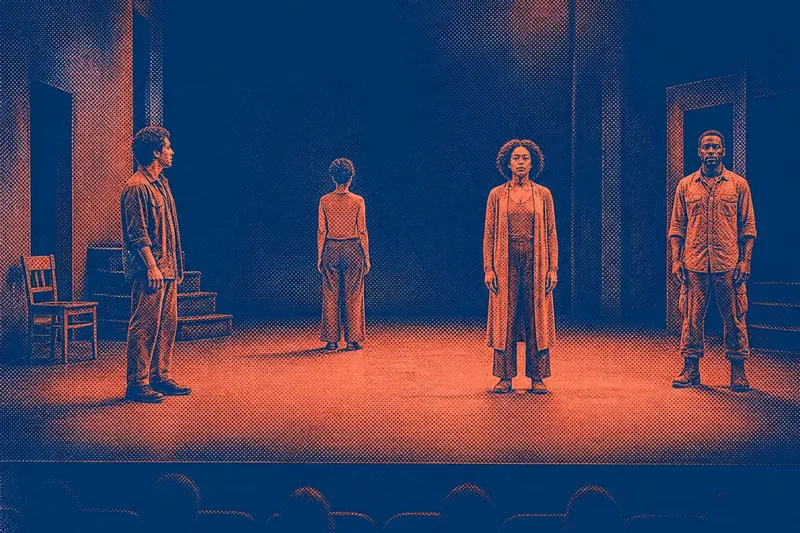
Two performers stand at opposite ends of a bare stage. One turns towards the other; the other keeps facing front. A stage picture—the arrangement of bodies, gaps and directions—already gives you something to read before either speaks.
Stay with what you can see. A position is a clue, not a fixed translation of a character’s thoughts. Track who faces whom, who has room to move and how the arrangement changes.
Read the space between performers
Close spacing can suggest intimacy, pressure, shared purpose or a lack of room. A wide gap can suggest separation or caution, but it may also be a pause before contact. Look at the surrounding action before choosing an interpretation.
Notice whether the gap is open or blocked by a chair, another body or a turned shoulder. Ask who can cross it freely and who would have to wait for someone else to move. Unequal access can make a distance feel more significant than its appearance alone.
Track the spacing across a scene. If one performer edges closer and the other retreats, the repeated adjustment forms a visible pattern. If both remain apart but turn towards the same object, their shared focus may connect them despite the gap.
Follow the direction of each body
A performer’s facing can matter as much as their position. A body turned towards another may suggest engagement; a shoulder turned away may suggest divided attention. Neither cue has a single meaning. A performer facing the audience might still be listening to someone behind them.
Look at the feet, torso and head together. Feet pointed towards an exit while the head stays turned towards a partner create a visible contrast in direction. Two performers facing the same way may be aligned, focused on a shared task or responding to someone else. Watch what happens next before settling on a reading.
Eye contact can sharpen a moment, but its absence does not automatically signal rejection. Check whether a performer is following a sound, addressing the audience or avoiding another person’s gaze. Then watch how the other performer responds.
Notice who controls access and attention
A person in the centre often draws the eye, especially when others orient towards them. That position might suggest authority, importance or exposure. A central performer can also look isolated if the others form a group around them.
Look for observable signs of control. Who initiates a shift? Who has a clear route through the space? Who waits for others to move? Someone at the edge may still hold attention if the group turns towards them or leaves their path open. A person in the centre may have little access if the surrounding group closes in.
Height changes the picture, but does not settle its meaning. A standing performer beside someone seated might appear dominant, vulnerable or simply occupied with a different task. Check whether the standing person leans in, turns away or makes room.
Watch how the group makes room
A line of performers can single someone out, particularly when everyone else faces them. A cluster can suggest solidarity, secrecy or pressure. Notice whether its members make room for anyone outside it. An arc may keep a person visible to the group while leaving them apart.
Openings matter. If a group forms a ring with a gap, notice who enters and who seems able to leave. If performers stand shoulder to shoulder, check whether they face the same direction or close the space around someone. The formation shapes routes and attention, not just the background.
Imagine four performers in an invented scene: three stand in a shallow line, and the fourth waits behind them. First, the line turns towards the fourth, making that person the focus of the group’s attention. Then the fourth steps forward and the others shift aside; the observable result is greater access to the shared space and a changed focus. That change supports an interpretation, but does not prove what any performer intends.
Track what changes as performers move
A still image can be striking, but a sequence of small adjustments often makes a relationship easier to follow. One performer crosses while another stays put. Someone turns away, then turns back at a sound. A third person enters and changes the spacing between a pair.
Notice who initiates and who responds. Does one performer set the pace while another adapts? Does a response come straight away or after a pause? Matching movements may suggest coordination; a delayed movement may make the connection feel uncertain. Look for a pattern rather than giving one gesture too much weight.
A change of position can redirect attention without changing the spoken words. Someone moving behind another may become less visible, or gain a view of the group. A performer stepping into a clear sightline can interrupt a pair’s exchange. Ask what the audience can see now and whose attention has shifted.
Check how light and sound frame the picture
A lighting change can isolate one performer while leaving a nearby partner in dimmer light. An offstage sound can turn the group’s attention in a shared direction. These cues can reinforce the arrangement or complicate it.
Ask whether the relationship still reads when the stage picture changes. Two performers may stand close, yet a pool of light can visually separate them. A sound may draw one person’s gaze away while another remains focused on them, making their difference in attention visible.
It is not worth assigning hidden meaning to every step, glance or lighting shift. Some movement helps performers reach a prop, keep a sightline clear or prepare for the next beat. Give a detail more weight when it repeats, draws a clear response or changes at a significant moment.
Questions to ask while reading a stage picture?
Does closeness always mean affection?
No. Close spacing can suggest comfort, pressure, urgency or the practical need to share a small area. Notice whether both performers choose the distance and what each does when one shifts.
How can you spot a hierarchy?
Look for repeated differences in access, initiative and attention. One performer may move while others make room, or stand at the edge while the group keeps its focus elsewhere.
What does it mean when performers face the audience?
Front-facing bodies can make a shared statement, leave someone exposed or divide attention between the audience and another performer. Check who else is watching and whether that position changes.
How can you tell whether a movement matters?
Look for a clear change in spacing, direction, access or group attention. If another performer responds or the arrangement returns in a changed form, the movement is part of a pattern worth noticing.
Make a useful viewing note
After a scene, write down who stood closest, who faced whom and what changed. Describe the action before interpreting it: “one performer backed away; the other followed” gives you more to work with than “they distrust each other”.
Then note who had the clearest route through the space and who had to wait or move aside. Compare those details with the next arrangement. This separates what you saw from what you inferred.
To read a stage picture, follow spacing, direction and access as they change. In your next performance, choose one relationship and watch what happens when someone steps closer, turns away or lets another person pass.
- Check who stands closest to whom; if both maintain the distance, note a shared position, and if one closes or widens it, record who changes the gap.
- Check where feet, torso and head point; if they align, note a consistent direction, and if they differ, record the competing focus instead of assigning a motive.
- Check who can cross the space without obstruction; if access is open, note the clear route, and if a person or object blocks it, track who must wait or move aside.
- Check who initiates a group shift; if others follow, note the response, and if they do not, record the contrast in movement.
- Check whether the group leaves an opening; if someone enters or exits through it, note the access, and if the gap stays unused, record who remains outside.
- Check what changes after a sound or lighting shift; if attention or visibility moves, note who gains focus, and if the arrangement stays the same, treat the cue as framing rather than a new relationship.