A Bare Floor or a Built Setting?
Learn how to read a bare stage or detailed setting through movement, sound and changing objects, so you can follow the performance without guessing symbols.
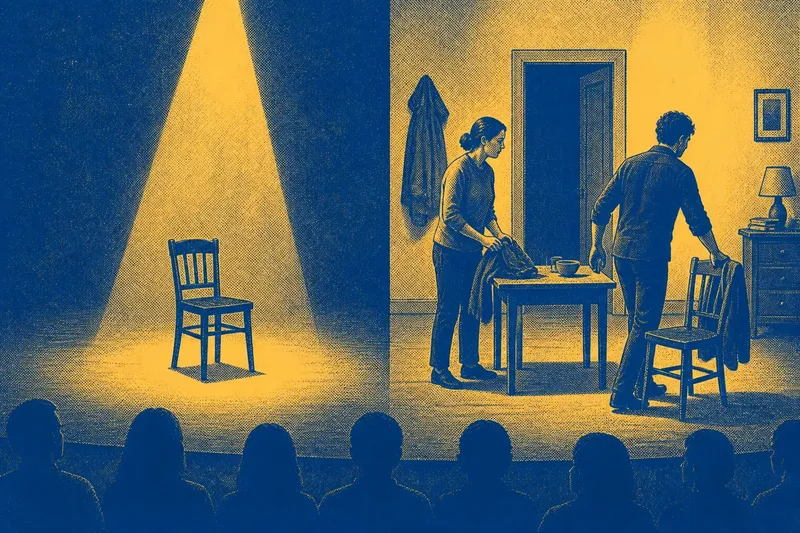
You settle into your seat and notice a chair standing alone beneath a strip of light. In another show, a table, doorway and cluster of everyday objects fill the stage. To read either kind of theatre setting, follow how performers use it, what sounds it produces and which details return.
Begin with the setting’s practical rules
Look for what the space permits or prevents. Can performers cross freely, or must they pass through a doorway? Is the chair available to anyone, or does one performer repeatedly claim it? These practical rules give you something observable to follow before you try to interpret the scene.
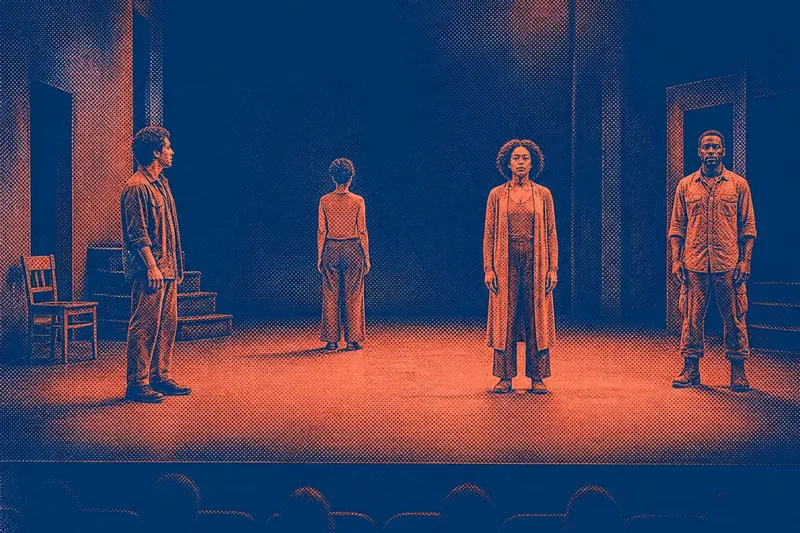
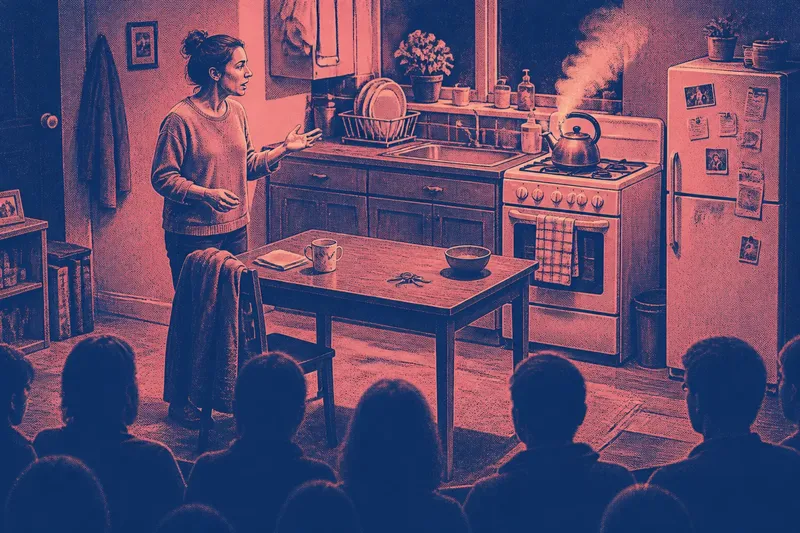
On an open floor, the rules may be established through repeated behaviour rather than walls. A performer might stop at the same invisible boundary each time. In a furnished room, a table may divide two people or block a direct path. Notice the action itself; avoid treating the layout as a code with one correct answer.
It is not worth mentally cataloguing every visible object. Choose a feature that affects what a performer does, then see whether the performance returns to it.
Follow repeated actions instead of mapping the stage
Rather than tracing every route or judging the overall stage picture, pick one repeated action: a performer sits, refuses to sit, or moves an object out of the way. Watch for a change in that action. Does the person who once avoided the chair eventually use it? Does someone else interrupt the routine?
Say you see a performer enter through a doorway, pause beside a table and leave a folded coat on a chair. Later, another performer shifts the chair, and the first person carries the coat away instead of replacing it. The starting details are a doorway, table, chair and coat; the actions are placing, moving and removing; the observable result is that the routine changes. You can note that change without deciding that the coat represents a particular idea.
Listen to how objects and voices alter the scene
Attend to sounds tied to actions: a chair scraping, a drawer closing, shoes crossing a hard floor or a voice becoming difficult to hear from one part of the stage. Ask what happened just before the sound and whether it changes the next action. This keeps listening connected to the performance rather than turning every noise into a symbol.
Silence can also mark a change. If speech stops after an object is moved, notice whether the performers resume, wait or leave. Compare what you hear in an open space with what you hear in a furnished one, but do not assume that a quiet pause means the same thing in both.
Check what changes as the scene develops?
What does a bare stage let performers do?
It may leave room for movement, repeated gestures or a single object to become noticeable. Watch what performers actually choose to do with that open floor rather than assuming that it has no boundaries.
How should I read a prop that appears more than once?
Track who handles it and whether its use changes. If it returns, compare the new action with the earlier one; leave its larger meaning undecided unless the performance gives you further clues.
What should I notice when the setting changes?
Notice what is added, removed or left behind, then watch how performers respond. A changed routine may be more telling than the visual alteration alone.
Do I need to interpret every detail?
No. Follow details that affect an action, recur or draw your attention in a clear way. An inventory of untouched objects can distract from what the performers are doing.
Use a short observation checklist
For each item, note the observation first, then make the indicated choice. If the observation is absent, take the alternative action rather than forcing an interpretation.
- Check whether a performer repeats the same action; if so, compare the next repetition for a change, and if not, follow a different action that recurs.
- Check whether an object is handled; if so, note who uses it and how, and if not, leave it aside unless it later affects the action.
- Check whether a route is blocked by furniture or a boundary; if so, watch how the performer responds, and if not, attend to where they choose to stop.
- Check whether a sound follows a visible action; if so, connect the sound to that action, and if not, listen for whether it recurs from elsewhere.
- Check whether speech or movement stops after a change; if so, observe what resumes first, and if not, follow the next clear shift in the scene.
- Check whether an object or action returns later; if so, compare its new use with the earlier one, and if not, stop tracking it and attend to the current action.
Compare the opening impression with what follows
Once the scene has developed, reconsider what first caught your attention. A chair that seemed incidental may become part of a repeated routine; a furnished room may matter less after performers stop using its objects. Describe the shift you observed before deciding what it suggests.
For a bare floor or a built setting, the useful question is not simply what the stage looks like. Ask what performers repeat, interrupt or leave unused, and what you hear alongside those choices. That gives you a specific account of how the setting participates in the action without requiring you to assign a fixed meaning to every detail.