A First-Time Play: What to Notice Between Scenes
Follow scene transitions in a first-time play by noticing what carries across, what is omitted and how the next scene answers—or resists—the change.
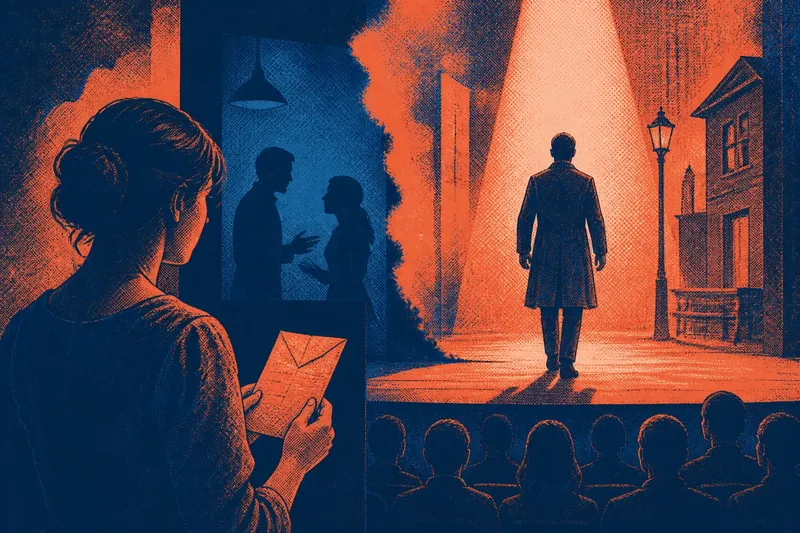
The blackout ends, but a low pulse continues while a performer walks into the light. In a first-time play, a scene transition can change not only what you see, but also what you are allowed to know. Follow how the performance releases information, withholds it or makes you wait.
You do not need to decode every cue. Instead, notice the sequence: what the previous scene leaves unresolved, what the transition conceals or carries forward, and what the next scene reveals. This makes the shift itself easier to follow without turning the performance into a puzzle.
Notice what the transition lets you know
A scene change can give you information, delay it or make an earlier detail newly uncertain. When a door closes before a character can answer, the interruption may leave the question active. When the next scene begins with the answer already in hand, the missing moment can matter as much as the explanation.
Keep three kinds of information in mind:
- Carried forward: a spoken phrase, sound or unfinished action continues across the change. If it does, notice whether it keeps the same meaning; if its context shifts, follow the new context rather than assuming the earlier meaning still applies.
- Withheld: a blackout, pause or cut interrupts an expected answer. If the next scene returns to the gap, keep the question open; if it moves elsewhere, let the omission remain unresolved for now.
- Reframed: a later scene presents a familiar event from another point of view. If the accounts conflict, compare what each person can know; if they agree, notice what the second account adds instead.
- Revealed late: a detail appears after the audience has formed an impression. If it changes how an earlier action reads, revise that impression; if it adds no new consequence, treat it as context rather than a reversal.
- Left uncertain: the scene gives clues without settling their meaning. If a later cue clarifies them, update your reading; if ambiguity persists, accept uncertainty as part of the scene’s design.
- Repeated: a phrase or action returns after a transition. If its delivery or consequence has changed, compare the two appearances; if it is unchanged, notice whether the repetition creates rhythm or continuity.
Follow the shape of the cut
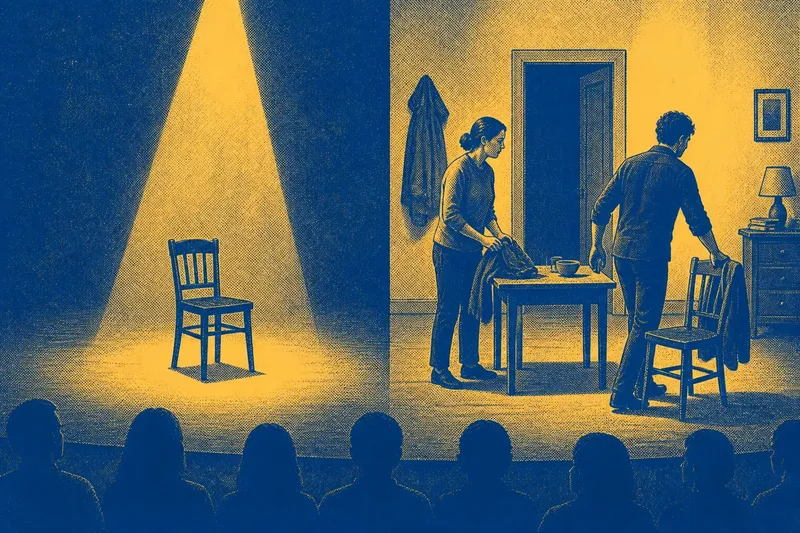
Some transitions make the break obvious: the lights go out, the audience waits, and the next scene starts. Others keep the action moving, with speech, movement or sound crossing the boundary. Notice whether the change feels like a full stop, an interruption or a handover.
A pause can leave you with an unfinished question. A sudden cut can make two events seem connected without explaining how. An overlapping voice may place the next scene in conversation with the last one. These are different kinds of structure, so ask what the cut does to your expectation rather than judging whether it is smooth.
It is not worth trying to assign a hidden meaning to every blackout or pause. Some changes simply give performers time to reset or let the next scene begin cleanly. Wait for the surrounding scenes to show whether a transition has a larger role.
Compare what each scene knows
In plays with secrets, mistaken beliefs or competing accounts, the audience’s knowledge may differ from a character’s. A transition can place you ahead of a character, keep you alongside them or leave you behind. That difference affects suspense: you may wait for someone to learn what you already know, or try to work out what they have not told you.
When a new scene begins, ask what has changed in the distribution of information. Has a private conversation become visible to the audience? Has a character entered without hearing what came before? Has a later account challenged an earlier one? These questions keep your attention on the play’s structure rather than on guessing the intended answer.
Use a simple question when the scene changes?
What should I follow if the change is very fast?
Choose one unfinished question from the scene that has just ended and see whether the next scene answers it, redirects it or leaves it open. If you miss the exact moment of the cut, start with the first clear piece of new information.
How can I follow a play with a non-linear story?
Separate what happens from when the audience learns about it. A scene may add a new event, revisit an earlier one or change your understanding of both; use the next transition to notice which of those things has happened.
What if two characters tell different versions?
Listen for what each account includes, avoids or could not have witnessed. If the play supplies no way to settle the conflict, keep both versions in mind rather than choosing one too early.
Should I take notes during the performance?
Only if writing will not pull you away from the action. A brief phrase in the interval, such as “answer delayed” or “second account changes first”, can help you recall a pattern without recording every cue.
Work through one transition in order
Say you are watching an invented play in which one scene ends with a character asking, “Who sent the message?” The next scene opens with a different character holding a folded note, but nobody explains where it came from. Here is a way to follow the shift:
- Remember the unresolved question: who sent the message.
- Notice what the transition carries across: the question is not answered in the scene break.
- Register the new information: another character has a folded note.
- Keep the connection provisional: the note may be the message, but the scene has not established that.
- Watch for the next cue: if the character reads or identifies the note, update your understanding; if the play moves on, retain the question without inventing an answer.
The resulting reading is specific but cautious: the next scene introduces a possible answer without confirming it. That distinction helps you follow suspense on the play’s terms, rather than filling every gap yourself.
Let repeated transitions shape your reading
Across the evening, notice whether the play tends to answer questions quickly, return to earlier moments or leave gaps between scenes. A repeated pattern can shape how you watch: if answers are often delayed, a fresh interruption may feel more significant; if viewpoints keep changing, a confident account may deserve comparison with the next one.
For a first-time play, track one unresolved question through a transition and see what the next scene does with it. The main search phrase, first-time play, does not call for a perfect interpretation; a careful distinction between what the scene tells you and what it leaves uncertain is enough to keep you oriented. If the play never closes a gap, that can be a meaningful result too.